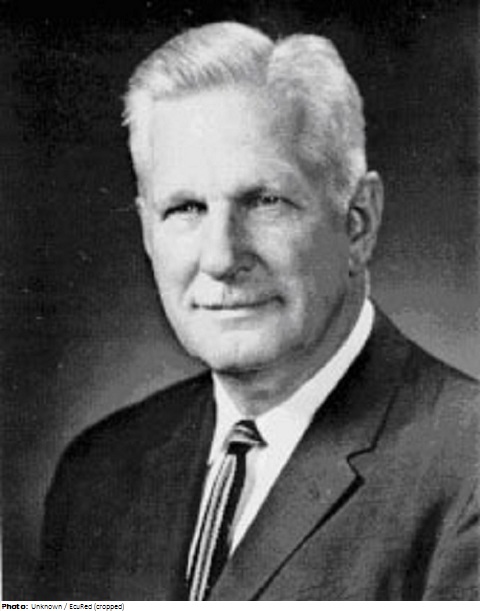
| Roles | Competed in Olympic Games |
|---|---|
| Sex | Male |
| Full name | Folke Karl•Skoog |
| Used name | Folke•Skoog |
| Born | 15 July 1908 in Fjärås, Kungsbacka, Halland (SWE) |
| Died | 15 February 2001 (aged 92 years 7 months) in Madison, Wisconsin (USA) |
| Measurements | 188 cm / 78 kg |
| Affiliations | Caltech, Pasadena (USA) |
| NOC |  Sweden Sweden |
Following a brief athletics career Folke Skoog became a leading scientific figure in the field of plant physiology. Skoog was born in Sweden in 1908 and emigrated to the United States in 1925. He then studied at the California Institute of Technology, earning a bachelor’s degree in chemistry in 1932. That same year he represented Sweden at Los Angeles Olympics where he ran in the 1,500 metres.
By 1935 Skoog had become an American citizen, gaining a PhD in biology the following year. After spells at Harvard and Johns Hopkins University he worked as a chemist at the US Department of Defense from 1944 to 1946. He then taught at the University of Wisconsin–Madison from 1947 until his retirement in 1979. Along with professor Toshio Murashige, he published his best known paper on plant tissue culture in 1962, which is now known as the Murashige and Skoog medium. Skoog was elected to the National Academy of Sciences in 1956 and as a foreign member of the Royal Swedish Academy of Sciences in 1970. In 1991 he was honoured by being awarded with the National Medal of Science.
Personal Best: 1500 – 3:59.2 (1932).
| Games | Discipline (Sport) / Event | NOC / Team | Pos | Medal | As | |
|---|---|---|---|---|---|---|
| 1932 Summer Olympics | Athletics | SWE |
Folke Skoog | |||
| 1,500 metres, Men (Olympic) | 6 h2 r1/2 | |||||
| 4 × 400 metres Relay, Men (Olympic) | Sweden |