| Roles | Competed in Olympic Games |
|---|---|
| Sex | Male |
| Full name | Mikhail Vasilyevich•Yekimov |
| Used name | Mikhail•Yekimov |
| Original name | Михаил Васильевич•Екимов |
| Born | 23 May 1865 |
| NOC |  Russian Federation Russian Federation |
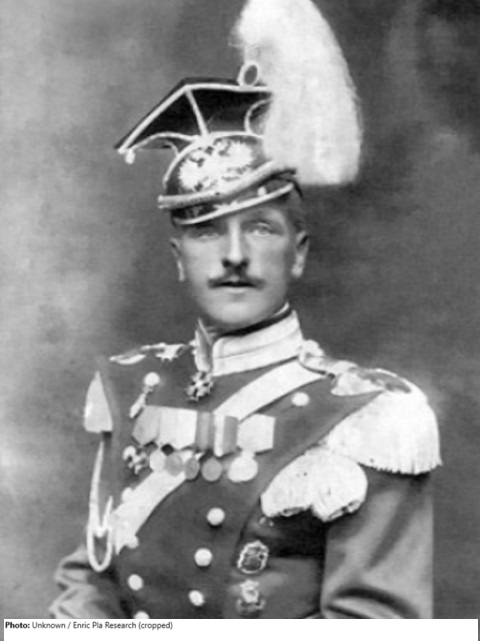
Mikhail Yekimov’s family came from Siberia in the mid-19th century, and his father worked in the government’s mining department. Mikhail graduated from the Tver Cavalry Cadet School in 1884 and from the Cavalry Officers’ School in St. Petersburg in 1900. Together with his brothers, he served in the 5th Dragoon Kargopol Regiment, stationed in Poland. He soon started competing in equestrian events and went on to win prizes in competitions among the cavalry regiments.
Yekimov was the only officer who volunteered to represent Russia in the dressage of the 1912 Olympic Games. With his horse Tritonich he placed a reasonable ninth in the individual event. Because many observers thought he did better than that, with judges’ rankings from third to 13th, he was later invited by the King of Sweden for a private performance as a gesture of consolation.
In World War I, Yekimov first served as captain in the 5th Dragoon Kargopol Regiment and was awarded the Orders of St. Vladimir, St. Stanislav and St. Anne. Later, he was appointed lieutenant colonel and commander of the 13th Uhlans Vladimir Regiment. With the Circassian Cavalry Regiment, he was sent to St. Petersburg in 1917 to protect the city. Eventually, the army under supreme commander Kornilov remained inactive. After the October Revolution, Mikhail and his son Georgy Yekimov joined the Red Army, with Mikhail as inspector of cavalry units in the Kazan and Volga military districts. His son was soon killed fighting against the Whites. Mikhail then returned to Petrograd (St. Petersburg). His brother Konstantin, also a tsarist cavalry officer, later became a full-time instructor at the Red Army’s Cavalry Advanced Training Courses for Command Personnel (KKUKS).
Yekimov also became a cavalry riding instructor and settled with his wife and two daughters in Pavlovsk (then named Slutsk) near Leningrad (St. Petersburg). He was dismissed in the dawn of the Great Purge. There is no information about his later life, particularly after the town was occupied in World War II.
| Games | Discipline (Sport) / Event | NOC / Team | Pos | Medal | As | |
|---|---|---|---|---|---|---|
| 1912 Summer Olympics | Equestrian Dressage (Equestrian) | RUS |
Mikhail Yekimov | |||
| Individual, Open (Olympic) | Tritonich | 9 |