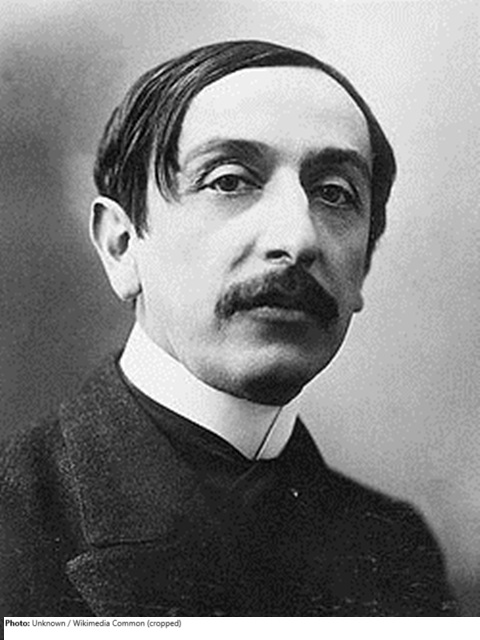
| Roles | Referee |
|---|---|
| Sex | Male |
| Full name | Auguste-Maurice•Barrès |
| Used name | Maurice•Barrès |
| Born | 19 August 1862 in Charmes, Vosges (FRA) |
| Died | 4 December 1923 (aged 61 years 3 months 16 days) in Neuilly-sur-Seine, Hauts-de-Seine (FRA) |
| NOC |  France France |
Maurice Barrès’ youth was clouded by the Franco-Prussian War of 1870/71 and the temporary loss of Alsace–Lorraine which shifted the border close to his birthplace Charmes and to Nancy, where he attended grammar school. He went to Paris in 1882 to study law and to start a literary career. Barrès even founded his own short-lived magazine Taches d’encre (Engl.: Ink Stains). His breakthrough came in 1888 with the novel Sous l’œil des barbares (Engl.: Under the Eyes of the Barbarians), the first part of an autobiographical trilogy of novels, written during a lengthy stay in Italy. In the same year, he was initiated into the Martinist Order, an esoteric movement of mystical Christianity. His literary works are attributed to symbolism and he was an intimate of Italian Gabriele d’Annunzio.
In 1889, Barrès became a supporter of the politically extreme right-wing nationalist and revanchist group of the “Boulangists” and represented them in the parliament of the Meurthe-et-Moselle constituency. Even after the dissolution of the movement, he remained active as a right-wing intellectual and politician. During the Dreyfus Affair in 1898, he took a stance against the falsely accused Jewish officer. During this time, he published another trilogy titled Le Roman de l’énergie nationale (English: The Novel of National Energy) about s group of young people committed to the reconquest of Alsace–Lorraine.
In 1906, Barrès was admitted to the Académie Française and elected deputy for the Seine constituency, which he remained until his death, although he actually held anti-parliamentarian views. In the following years he completed another trilogy of novels, Les bastions de l’Est (English: The Bastions of the East) full of nationalist anti-German resentment and the official Roman Church. In 1914, Barrès became head of the anti-German, anti-Semitic, and anti-parliamentary “League of Patriots” writing daily militaristic newspaper articles during World War I. However, he now distanced himself from his earlier anti-Semitism. After the war, Barrès rallied for the annexation of Luxembourg by France.
Now Barrès became the negative figure in French literature circles, particularly among the Surrealists. Their mastermind André Breton instigated a fictious show trial against Barrès. Nevertheless, he was still admired for his sophisticated language, even by politically left-wing intellectuals, including the later president François Mitterrand, and continued to influence important French writers.
Barrès is listed among the members of the art jury but died about half a year prior to the Olympic Games.
| Games | Sport (Discipline) / Event | NOC / Team | Phase | Unit | Role | As | |
|---|---|---|---|---|---|---|---|
| 1924 Summer Olympics | Literature | FRA |
Maurice Barrès | ||||
| Literature, Open (Olympic) | Final Standings | Final Standings | Judge |