| Roles | Other |
|---|---|
| Sex | Female |
| Full name | Hélène•Ahrweiler (Glykatzi-) |
| Used name | Hélène•Ahrweiler |
| Other names | Ελένη Αρβελέρ (Γλύκατζη-) |
| Born | 29 August 1926 in Athina (Athens), Attiki (GRE) |
| Died | 16 February 2026 (aged 99 years 5 months 18 days) in Athina (Athens), Attiki (GRE) |
| NOC |  France France |
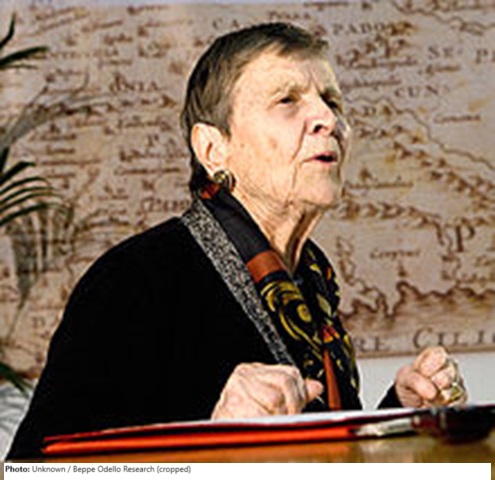
Born in Athens in 1926 to parents from Asia Minor, Eleni Glykatzi-Ahrweiler developed a passion for history at a very young age. Her past as a refugee and her family history played a decisive role in this choice. After joining the Resistance during the Second World War, she studied at the University of Athens before leaving for France in 1953.
In Paris, she met her future husband, Jacques Ahrweiler (1918-2010), an officer in the French Navy, with whom she had a daughter, Marie-Hélène. In 1955, she joined the French National Centre for Scientific Research (CNRS) as a researcher, and was later promoted to senior research fellow. In 1967, she left the CNRS to become a professor at the Sorbonne in Paris.
She became the first woman in the seven hundred-year history of the French institution to hold the highest administrative positions: head of department, university president, and rector.
In 1982, President François Mitterrand appointed her rector of the Academy of Paris and chancellor of the universities of Paris, making her the first woman to hold one of the most prestigious positions in the French national education system.
For this historian, Byzantium was not simply an object of study, but a veritable laboratory of political thought, social organization, and cultural continuity. Her influence on European academic institutions was considerable.
She was director of the history department and chair of the research committee at the Faculty of Arts and Humanities of the Sorbonne University (1969-1970), a visiting professor at Harvard University (1973-1974), and received honorary doctorates from numerous universities, from London to New York. She was also a UNICEF Goodwill Ambassador and frequented artists such as Simone de Beauvoir, Louis Aragon, Pablo Picasso, and Françoise Sagan in Paris.
During the financial crisis and tensions with Turkey, she was frequently interviewed by the Greek media about Greek and European identity. “Homeland is an emotion; it is the place that holds our memories and emotions. Homeland is our common interests, the ‘we,’” the Byzantinologist, who lived much of her life in France, notably declared.
Her numerous and widely translated writings remain a key reference for Byzantinology, as well as for understanding Greece’s relations with Europe and the Mediterranean.
Greek President Konstantinos Tasoulas paid tribute to the woman “who illuminated through her work the timeless dimension of Greek identity” and “contributed decisively to the international recognition of Byzantium as a fundamental pillar of European civilization.”
| Games | Role | NOC | As | |
|---|---|---|---|---|
| — | Other | FRA |
Hélène Ahrweiler |