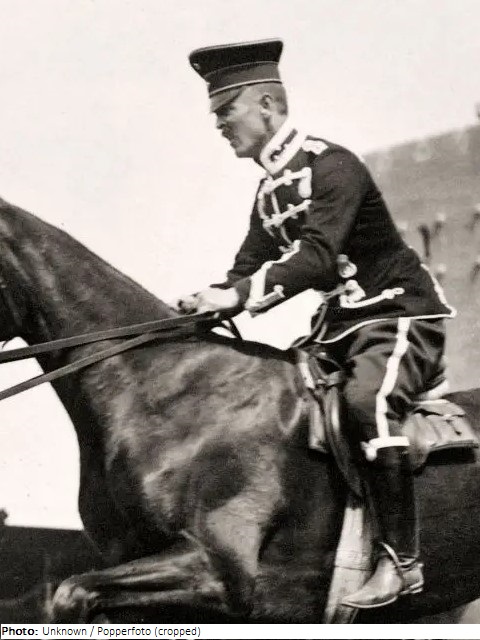
| Roles | Competed in Olympic Games |
|---|---|
| Sex | Male |
| Full name | Carl Bernhard•von Moers |
| Used name | Carl•von Moers |
| Born | 9 December 1871 in Neuwied, Rheinland-Pfalz (GER) |
| Died | 26 May 1957 (aged 85 years 5 months 17 days) in Bonn, Nordrhein-Westfalen (GER) |
| NOC |  Germany Germany |
| Medals | OG |
| Gold | 0 |
| Silver | 1 |
| Bronze | 0 |
| Total | 1 |
Carl von Moers was the son of First State Prosecutor Karl von Moers and joined the Royal Prussian Army in 1891 in the Pomeranian Hussar Regiment “Prince Blücher von Wahlstatt” No. 5 in Stolp (now Słupsk in Poland). In the following years, he was promoted to second lieutenant after attending the military academy. After several years of service, he was transferred to the reserve. From 1899, von Moers was seconded to the 2nd Westphalian Hussar Regiment No. 11 in Düsseldorf and promoted to lieutenant, and to first lieutenant in 1901.
In 1901, von Moers married Emilie Deddine Josephine ‘Emy’ Kempe, who was 10 years younger than him. Later that year, he joined the Military Riding Institute in Hannover for three years. In 1905, he returned to his regiment, which had been relocated to Krefeld. Three years later, he rose to the rank of captain and squadron commander. From 1910, he was deployed as a riding instructor at the Military Riding Institute. Von Moers was a successful dressage and eventing rider himself. He came in 12th in the individual dressage on his horse New Bank. He finished 15th in the individual three-day-event at the 1912 Stockholm Olympics on his horse May-Queen and won the team silver medal. Von Moers retained his position as a riding instructor until his mobilization for World War I. In the meantime, promoted to major, he was the commander of the 1st Hanoverian Dragoon Regiment, “King Charles I of Romania” No. 9.
After the war, von Moers became commander of the officers’ riding school in Paderborn but was soon transferred to his former regiment, the 11th Hussars. In 1919, he was accepted into the provisional Reichswehr as a major. With the formation of the new Reichswehr in 1920, von Moers became a major to the staff of the 15th Cavalry Regiment in Paderborn and subsequently lieutenant colonel. One year later, he was appointed commander of the 13th (Prussian) Cavalry Regiment in Hannover and held this position until his discharge from active service in 1923. In the mid-1930s, von Moers lived in Dortmund and later worked as a merchant in Düsseldorf.
| Games | Discipline (Sport) / Event | NOC / Team | Pos | Medal | As | |
|---|---|---|---|---|---|---|
| 1912 Summer Olympics | Equestrian Dressage (Equestrian) | GER |
Carl von Moers | |||
| Individual, Open (Olympic) | New Bank | 12 | ||||
| Equestrian Eventing (Equestrian) | GER |
Carl von Moers | ||||
| Individual, Open (Olympic) | May-Queen | 15 | ||||
| Team, Open (Olympic) | May-Queen / Germany | 2 | Silver |