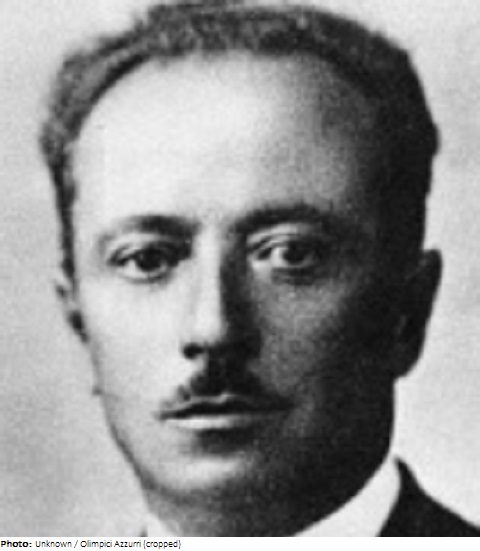
| Roles | Competed in Olympic Games |
|---|---|
| Sex | Male |
| Full name | Serafino•Mazzarocchi |
| Used name | Serafino•Mazzarocchi |
| Born | 7 February 1890 in Montegranaro, Fermo (ITA) |
| Died | 21 April 1961 (aged 71 years 2 months 14 days) in Bologna, Bologna (ITA) |
| Affiliations | S.G.S. Panaro, Modena (ITA) |
| NOC |  Italy Italy |
| Medals | OG |
| Gold | 1 |
| Silver | 0 |
| Bronze | 1 |
| Total | 2 |
Serafino Mazzarocchi was born in the Marche region but represented the “Panaro” club in Modena after a short spell in Turin and the local “Società Ginnastica”. In 1908 and 1909, he achieved his first successes at various competitions in Italy and Switzerland with the “Panaro” team, undoubtedly the strongest in Italy. He was selected as a reserve for the 4th Artistic Gymnastics World Championships in conjunction with the 9th Federal Festival held in Luxembourg. In 1910, the victory in Ancona was his first in a major individual event. In the meantime, he had joined the 36th Infantry Regiment, stationed in Modena, and was occupied by military duties for most of the year 1911.
Mazzarocchi earned a spot on the Italian team for the 1912 Olympic Games although he finished only 12th in the artistic gymnastics selection event held in June in Bologna. After attending a pre-Olympic training camp in Brescia, he was a member of the Italian team who won gold in the team event in the European System, which focussed on apparatus exercises. In addition, he won bronze in the individual all-around event finishing only behind his clubmate from Modena, Alberto Braglia, and the Frenchman Louis Ségura. With the Germans, Norwegians, and Swedes being absent the top eleven places were monopolized by French and Italian gymnasts. Mazzarocchi’s best apparatuses were the pommelled horse, where he finished first – tied with Braglia – and the horizontal bar, where he tied for second place. In official reports, the bronze was credited to Adolfo Tunesi for many decades, who had been officially registered for the event but was unable to compete. At the last minute and anonymously in his teammate’s place, Mazzarocchi stepped in for Tunesi to win bronze. Mazzarocchi continued to compete at both national and European levels for several years, but with diminishing success.
After his competitive career, he became a sports instructor for the Fiat group in Turin, specialising in gymnastics. In 1925, he introduced Italy’s first system for a regular recording of physiological and medical data for individual athletes in charts. Mazzarocchi became a professor of physical education and head of the first Institute for Physical Education Teachers and later of the National Academy in Rome. Eventually, he worked as a physical education instructor at the Bologna Study Centre.
He wrote two significant textbooks: “Ginnastica da Camera per la donna” (Home Gymnastics for Women) and “Manuale di Educazione Fisica” (Physical Education Manual). The latter was repeatedly printed from 1940 well into the 1970s.
| Games | Discipline (Sport) / Event | NOC / Team | Pos | Medal | As | |
|---|---|---|---|---|---|---|
| 1912 Summer Olympics | Artistic Gymnastics (Gymnastics) | ITA |
Serafino Mazzarocchi | |||
| All-Around, Individual, Men (Olympic) | 3 | Bronze | ||||
| Team, Men (Olympic) | Italy | 1 | Gold |