| Roles | Coach |
|---|---|
| Sex | Male |
| Full name | Park•Man-Bok |
| Used name | Park•Man-Bok |
| Name order | Oriental |
| Born | 30 August 1936 in Sokcho, Gangwon (KOR) |
| Died | 26 September 2019 (aged 83 years 27 days) in Lima, Lima (PER) |
| NOC |  Peru Peru |
| Nationality |  Republic of Korea Republic of Korea |
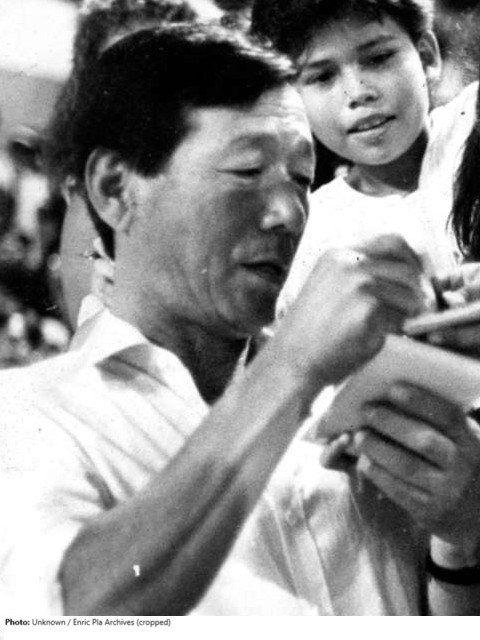
Born in Korea in 1936, Park Man-Bok later moved to Peru, where he became synonymous with the sport of volleyball in the country. Park played volleyball from his school days and continued to do so whilst studying at Kyung Hee University in Seoul. He studied as a pharmaceutical chemist, graduating in 1960. For the next four years Park served in the Korean Army, reaching the rank of sergeant, before returning to civilian life where he continued as a volleyball coach. By 1973 he had become the head coach of the women’s national team, which won bronze at the World Cup in Uruguay.
Park was then offered an opportunity to coach the Peruvian women’s national volleyball team, moving to the country in 1974. His predecessor, Akira Kato, had fallen ill, with Park taking up the role as head coach almost immediately. The Peruvian women’s team began a slow rise up the world rankings, first placing eighth at the 1974 World Championships, before finishing seventh at the 1976 Montréal Olympics. This was followed by back-to-back golds at the South American Championship in 1977 and 1979, and sixth at the 1980 Moskva Olympics.
The 1980s were the most successful for the women’s team under Park’s leadership. At the 1982 World Championships they finished as the runners-up, only losing to hosts China in the final. The team’s Olympic record was steadily improving too, finishing fourth at the 1984 Los Angeles Games, before winning silver four years later in Seoul. It was agonisingly close for the Peruvian women in Korea after taking the first two sets in the final, before the Soviet team made a comeback to win three sets to two. One year earlier Park also led the team to silver at the Pan American Games.
Park continued to coach the Peruvian women’s national team until 1992, when he moved to Japan to coach there for the next six years. He was still popular in Peru, returning to the country at the end of the 1990s to resume his role as the women’s head coach. In 1999 he led them at the FIVB World Cup before making his fifth appearance at the Olympics as the team’s head coach for the 2000 Games in Sydney.
During his long career Park was honoured multiple times, including being named the best coach in the world in 1987 by the International Volleyball Federation and receiving the Sports Laurels in the rank of “Grand Officer” from the Peruvian Sports Institute one year later. He later worked as an adviser to the Peruvian Volleyball Federation and was inducted into the International Volleyball Hall of Fame as a coach.
| Games | Sport (Discipline) / Event | NOC / Team | Pos | Medal | Nationality | As | |
|---|---|---|---|---|---|---|---|
| 1976 Summer Olympics | Volleyball (Volleyball) | PER |
KOR |
Park Man-Bok | |||
| Volleyball, Women (Olympic) | Peru | 7 | |||||
| 1980 Summer Olympics | Volleyball (Volleyball) | PER |
KOR |
Park Man-Bok | |||
| Volleyball, Women (Olympic) | Peru | 6 | |||||
| 1984 Summer Olympics | Volleyball (Volleyball) | PER |
KOR |
Park Man-Bok | |||
| Volleyball, Women (Olympic) | Peru | 4 | |||||
| 1988 Summer Olympics | Volleyball (Volleyball) | PER |
KOR |
Park Man-Bok | |||
| Volleyball, Women (Olympic) | Peru | 2 | Silver | ||||
| 2000 Summer Olympics | Volleyball (Volleyball) | PER |
KOR |
Park Man-Bok | |||
| Volleyball, Women (Olympic) | Peru | =11 |