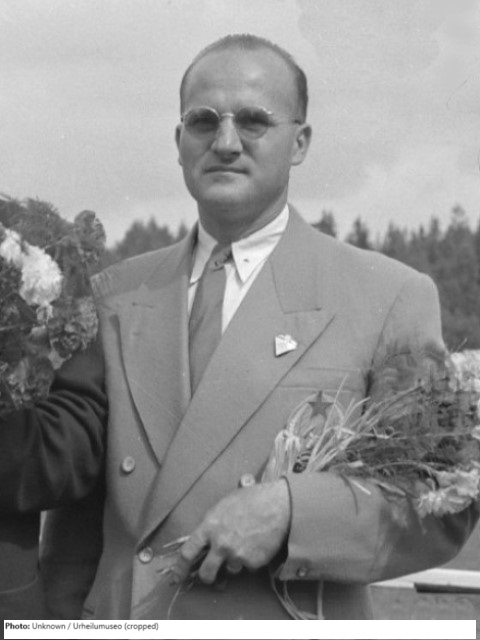
At the age of ten Balogh Ambrus started his shooting career with the air rifle. Five years later he started competing in the high school championship before competing regularly when he turned 18. From 1935 to 1944 he was a member of the Budapest University of Technology Shooting Association, from 1947 the Budapest Partizán SC, from 1949 the Metal and Machine Tool Factory, from 1957 the MHSZ Central Shooting Club, from 1959 the Újpesti Dózsa, and from 1964 to 1968 the United Officers’ School. He competed in several disciplines, winning the Hungarian championship one hundred and three times from 1935 to 1968, forty-two of which were individual, and from 1935 to 1966 he competed for the Hungarian national team. At the 1935 World Championships in Roma he was a member of the sixth-placed small-bore rifle team. In 1937 he was fifth in the individual and sixth in the team in Helsinki. In 1939 he won a bronze medal in Lucerne and was fourth with the team. He was seventh at the 1948 London Olympics and third in Helsinki in 1952. At the 1958 Moskva World Championships he was a member of the silver-medal small-bore rifle team, the bronze-medal large-bore rifle team, the fourth-placed military rifle team, the fourth-placed military rifle team, and the sixth-placed small-bore rifle team. At the 1960 Roma Olympics he was sixteenth in the individual and sixteenth in the sport pistol.
Balogh graduated from the Technical University with a degree in mechanical engineering. During World War II he served as an aircraft inspector for the army and was then taken prisoner by the Russians. After returning home he became a lecturer at the National Sports Office. From 1949 he worked as a weapons designer at the Lamp Factory (later the Weapon and Gas Device Factory). He designed numerous sports pistols. From 1964 until his retirement he was the head teacher of technical subjects at the Zalka Máté Military Technical College. He was an outstanding literary and educational figure.
 Hungary