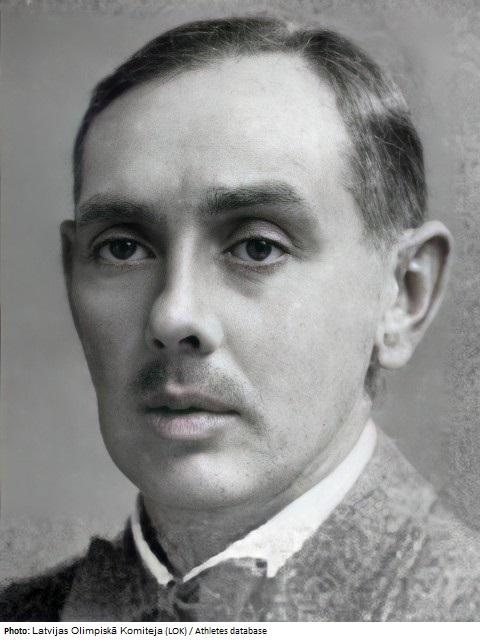
| Roles | Competed in Olympic Games |
|---|---|
| Sex | Male |
| Full name | Haralds Karl Adolf "Harry"•Blaus |
| Used name | Harry•Blaus |
| Other names | Harald Blau, Гарри Блау |
| Born | 5 February 1885 in Liezere, Madonas novads (LAT) |
| Died | 4 August 1944 (aged 59 years 5 months 27 days) in Haunstetten, Augsburg, Bayern (GER) |
| Affiliations | 1. RRB |
| NOC |  Russian Federation Russian Federation |
| Nationality |  Latvia Latvia |
| Medals | OG |
| Gold | 0 |
| Silver | 0 |
| Bronze | 1 |
| Total | 1 |
Harry Blaus was the son of one of the first doctors on the Latvian countryside. In 1906, he entered the Department of Architecture of Riga Polytechnic Institute and eventually graduated in 1913. During this period, he got interested in competitive shooting and joined the joined the Āgenskalns Rifle Society (Hagensberger Schuetzengesellschaft zu Riga). With a background in hunting, he competed in trap shooting winning the bronze medal with almost no training.
Blaus continued to achieve good results in clay pigeon events for almost 25 years. In 1932, he became the first national champion. In 1936, he set Latvian national records in trap shooting, first with 93 pigeons out of 100 and later that year with 99 pigeons. He was a nine-time Latvian Champion in various shooting disciplines (1926, 1928, 1930–1935, 1938). Blaus was also an excellent figure skater even before turning to shooting winning the first Latvian state championships in 1926. He repeated this feat in 1928 and 1929. Later, his two children also competed in figure skating.
Blaus also played tennis and held different posts in various sports clubs. In 1926, he was the co-founders of the Cynology Section of the Latvian Hunters Society.
After his graduation, Blaus joined the Russian army and worked as an architect and engineer at the headquarters of the apartment supply for the troops of the Russian Empire in St. Petersburg and Helsinki. In 1917, he returned to Latvia. After initially working for the railways, he became assistant to the head of the Division of Construction Inspection of the Road and Building Administration in 1920. He then worked as an architect for the insurance company “Rossia”, but it was liquidated three years later. In 1923, he joined the insurance and transport company “Latvija”, where he worked until 1930. Additionally, he started giving lectures as a construction teacher at the Riga State Technical School.
During the 1930s he published two books: one on Building Construction for Vocational Schools and Technical Schools (in 1932) and the second on The Art of Shooting with a Shotgun: A Handbook for Hunting and Sport Shooting (in 1935).
In 1938, Blaus retired and retreated to his wife’s native house near Valmiera, the former Kauguri Manor. Here, he devoted himself to hunting and breeding dogs. For his dogs he was awarded several prizes at exhibitions and acted as a judge.
During World War II, Blaus moved to Germany to undergo treatment for his tuberculosis, from which he suffered already for some time. He died in 1944 near the Bavarian city of Augsburg.
| Games | Discipline (Sport) / Event | NOC / Team | Pos | Medal | Nationality | As | |
|---|---|---|---|---|---|---|---|
| 1912 Summer Olympics | Shooting | RUS |
LAT |
Harry Blaus | |||
| Trap, Open (Olympic) | 3 | Bronze | |||||
| Running Target, Single Shot, Men (Olympic) | 20 | ||||||
| Running Target, Single Shot, Team, Men (Olympic) | Russia | 5 |