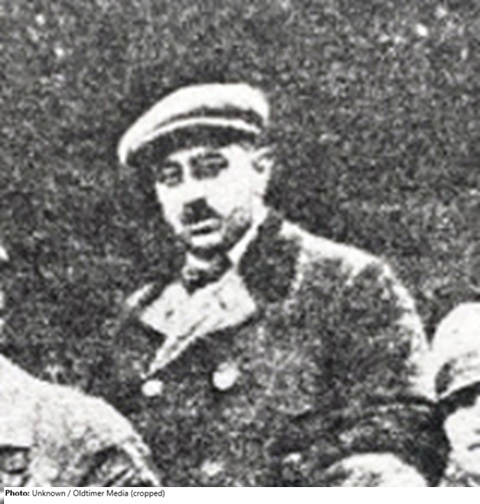
| Roles | Non-starter |
|---|---|
| Sex | Male |
| Full name | Gyula•Pivynik |
| Used name | Gyula•Pivynik |
| Born | 1 April 1885 in Nyíregyháza, Szabolcs-Szatmár-Bereg (HUN) |
| Affiliations | NyTVE, Nyíregyháza (HUN) |
| NOC |  Hungary |
Gyula Pivnyik was a versatile athlete from Nyíregyháza and represented the local Gymnastics and Fencing Club (NyTVE). In 1909, he took part in a classical Hellenic pentathlon (standing long jump, javelin throw, Greek style discus throw, 198 m race, wrestling) against four top athletes from Budapest including brothers István and Imre Mudin. Pivnyik achieved his best results in standing jumps and shot put but also competed in the 100 yd dash, 4 x 100 m relay, running high jump, and discus throw. In the standing long and high jump, he won national competitions even setting Hungarian records in these events. In 1912, he was entered for the standing long jump at the Stockholm Olympics but did not start. In results, Pivnyik reappeared in 1920, but only in shot put. Later, he became a member of the board of the club and acted as a jury member.
As a trainee notary and deputy civil registrar, Pivnyik started his career prior to World War I. In 1918, he was employed in the city administration of Nyíregyháza. In his position, he not only survived the short-lived Hungarian Soviet Republic as a member of the Worker’s Council but was even promoted. In the successor state under Miklós Horthy, he was a tax official and soon replaced his fallen ill superior. In 1922, he was officially appointed chief audit officer, a position in which he was responsible for the city’s budget. He was a well-respected officer and took over additional responsibilities such as member of the supervisory board of the Nyíregyháza Municipal Industrial Joint-Stock Company. Pivnyik held also various honorary positions in the cultural, sporting and social life.
An audit in October 1929 revealed the embezzlement of more than 40,000 pengős to pay his personal debts. Although the incident implicated several officials, there were only two casualties: chief auditor Gyula Pivnyik was dismissed from City Hall, while one of his subordinates committed suicide after the scandal broke. Pivnyik was released on bail but in 1930 was sentenced to six years in a penitentiary and 10 years of loss of civil rights. The verdict was approved in a revision in 1934.
| Games | Discipline (Sport) / Event | NOC / Team | Pos | Medal | As | |
|---|---|---|---|---|---|---|
| 1912 Summer Olympics | Athletics | HUN |
Gyula Pivynik | |||
| Standing Long Jump, Men (Olympic) |