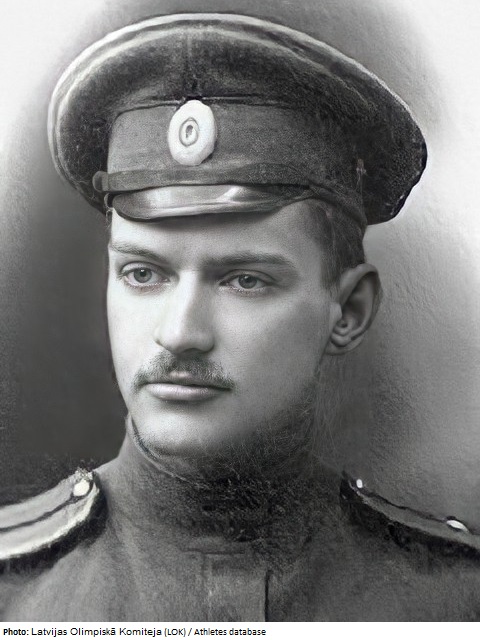
| Roles | Competed in Olympic Games |
|---|---|
| Sex | Male |
| Full name | Arnolds Pēteris•Indriksons |
| Used name | Arnolds•Indriksons |
| Other names | Арнольд Петер Индриксон, Arnold Peter Indrikson |
| Born | 1 September 1893 in Rīga, Rīga (LAT) |
| Died | 27 June 1941 (aged 47 years 9 months 26 days) |
| Affiliations | Rīgas II Riteņbraucēju Klubs |
| NOC |  Russian Federation Russian Federation |
| Nationality |  Latvia Latvia |
Arnolds Indriksons was born in Rīga as the son of a merchant. He graduated from the Rīga Commercial School and studied for two semesters at the St. Petersburg Agricultural Institute. In 1910, he joined the 2. Riga Cycling Club but soon focused on middle distance running. At the 1912 All-Russian Olympics, he placed second in the 400 m and qualified for the Stockholm Olympics. There, however, he competed in the1,500 m and did not advance to the second round.
In 1913, he entered the Oranienbaum Ensign School in Germany. With the beginning of World War I, Indriksons was drafted into military service and in October 1915 promoted to the rank of ensign. During World War I, he quickly climbed to the position of company commander. In June 1916, he was wounded and evacuated. After recovering, he was promoted to staff captain. In the Russian Civil War, he fought for the Whites in the so-called Yudenich Army and was wounded twice more until 1920. For his service he was awarded the orders St. Anna, St. Stanislav, and St. George. After returning to Latvia, Indriksons served in the Latvian Army as a senior lieutenant in the headquarters of the Army commander-in-chief. He also worked at the Latvian Consulate in Leningrad (now St. Petersburg) as a diplomatic courier.
He married Eugenie Ruchevsky, Jr. and had two daughters, born in 1923 and 1924. Indriksons then worked in the management of the Ligatne paper mill. His family followed him to live in the village of Ligatne in 1938. Soon after the occupation by Russia in 1940, he was arrested in his apartment and transferred to the notorious Butyrk prison of the NKVD in Moskva (Moscow). He was charged with “providing assistance to the international bourgeoisie, espionage and active struggle against the working class and the revolutionary movement” and he was executed by firing squad.
Arnolds Indriksons mortal remains have never been recovered. His family went to Australia after World War II. In 1997, he was rehabilitated by the Russian general prosecutor’s office.
Personal Best: 1500 – 4:26.4 (1914).
| Games | Discipline (Sport) / Event | NOC / Team | Pos | Medal | Nationality | As | |
|---|---|---|---|---|---|---|---|
| 1912 Summer Olympics | Athletics | RUS |
LAT |
Arnolds Indriksons | |||
| 1,500 metres, Men (Olympic) | 6 h4 r1/2 |