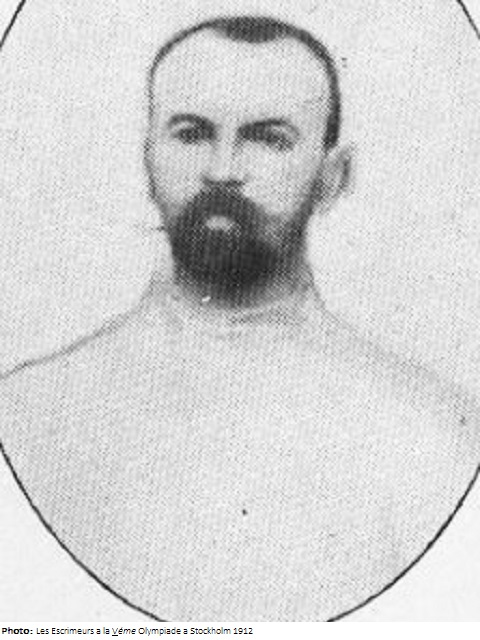
| Roles | Competed in Olympic Games |
|---|---|
| Sex | Male |
| Full name | Vladimir Iosifovich•Sarnavsky |
| Used name | Vladimir•Sarnavsky |
| Original name | Владимир Иосифович•Сарнавский |
| Born | 19 May 1875 in St. Petersburg, St. Petersburg (RUS) |
| Died | 1938 |
| NOC |  Russian Federation Russian Federation |
A descendant of a noble Ukrainian family, Vladimir Sarnavsky attended the Vladimir-Kyiv Cadet Corps to become a non-commissioned officer in 1894. One year later, he graduated from the 2nd Konstantinovsky Military School and joined the 37th Artillery Brigade as a second lieutenant. Beginning in 1900, he was an assistant to the head clerk of the Main Artillery University and became a staff captain in 1902. In 1903, he graduated from the St. Petersburg Archaeological Institute, and in 1904, he was assigned to the permanent staff of the Officer Artillery School, where he had various administrative duties. From 1906, he was treasurer of the school in the rank of a captain and head of the stables one year later.
In 1907 and 1908, Sarnavsky drew attention to himself as a fencer by winning the imperial prize for fencing combat with rapiers. He was then dismissed from his post as a treasurer and became a fencing instructor at the Konstantinovsky Artillery School and subsequently seconded to the Main Gymnastics and Fencing School. He joined the permanent staff of the school and was adjutant of the school from 1910. In 1912, Sarnavsky competed in the Olympic Games in Stockholm with minor success in the individual foil and épée and the épée team events. In all three tournaments, he was eliminated in round one. One of the organisers of the First All-Russian Olympiad in Kyiv in 1913, Sarnavsky placed third in épée fencing. Although remaining on the staff of the Main Gymnastics and Fencing School, he was then transferred to the Guards’ light artillery. Sarnavsky was chairman of the National Society of Sports Lovers, an honorary member of several St. Petersburg sports societies and a member of the Russian Olympic Committee.
Sarnavsky participated in World War I as a staff officer (lieutenant colonel) for production and head of the artillery unit of the headquarters of the 10th Army. In 1915, he became commander of the 2nd Battery of the 29th Artillery Brigade and also served repeatedly as acting commander of the 1st Division of this brigade. In August 1915, he was shell-shocked in a battle near Merkine, now in Lithuania. About one year later, Sarnavsky returned to the field as commander of the 1st Division of the 45th Artillery Brigade. In 1917, he was sent to Tsarskoye Selo, where the Tsar had his residence, to join the newly formed artillery battalion of Major General von Stein (Fonshtein). He was awarded various degrees of the Orders of St. Stanislav, St. Anna and St. Vladimir.
After the Russian Revolution, Sarnavsky served as a colonel and commander of the 1st Mountain Artillery Regiment in the army of the short-lived Ukrainian state (1917-18). Later, he lived in Kyiv and worked as a coach.
| Games | Discipline (Sport) / Event | NOC / Team | Pos | Medal | As | |
|---|---|---|---|---|---|---|
| 1912 Summer Olympics | Fencing | RUS |
Vladimir Sarnavsky | |||
| Foil, Individual, Men (Olympic) | =5 p12 r1/4 | |||||
| Épée, Individual, Men (Olympic) | =4 p4 r1/4 | |||||
| Épée, Team, Men (Olympic) | Russia | =9 |